


Wudu (ablution) is the washing that prepares a Muslim to stand before Allah in prayer. Without it the prayer is not accepted: the Prophet said, “The prayer of a person who does hadath is not accepted until he performs wudu” (Bukhari 135), and he called purification “the key to prayer” (Tirmidhi 3). This guide walks through wudu step by step as the Companions described the Prophet doing it, for new Muslims, young people and anyone who would like to check they are doing it well.
Wudu in the Qur’an
Allah describes wudu directly in Surah al-Ma’idah: “O you who have believed, when you rise to pray, wash your faces and your forearms to the elbows, wipe over your heads, and wash your feet to the ankles” (al-Ma’idah 5:6). These four acts, washing the face, washing the arms, wiping the head and washing the feet, are the obligatory core of wudu that every school of Islamic law agrees on. The rest of the steps below come from the Sunnah, the way the Prophet showed his Companions.
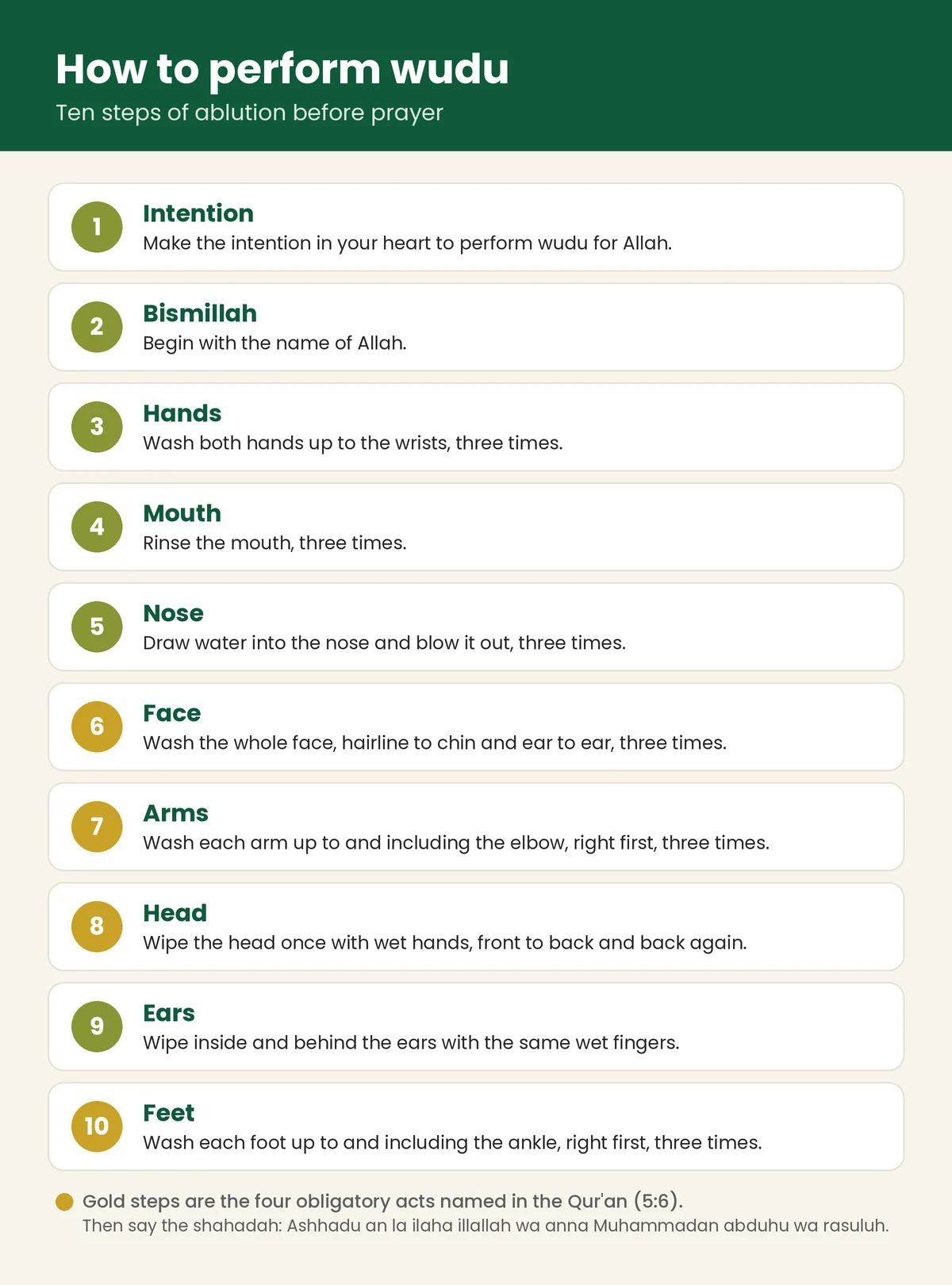
How to perform wudu, step by step
‘Uthman ibn ‘Affan showed the Prophet’s wudu by doing it in front of the people: he washed his hands three times, rinsed his mouth and nose, washed his face three times, his arms to the elbows three times, wiped his head and washed his feet to the ankles three times (Bukhari 159). In detail:
- Intention (niyyah). In your heart, intend to perform wudu to purify yourself for prayer. It does not need to be spoken.
- Say “Bismillah”. Begin in the name of Allah.
- Wash your hands. Wash both hands up to the wrists three times, making sure water passes between the fingers.
- Rinse your mouth. Take water into your mouth with the right hand, swirl it and spit it out, three times.
- Clean your nose. Draw a little water into the nose with the right hand and blow it out with the left, three times.
- Wash your face. Wash the whole face three times, from the hairline to below the chin and from one ear to the other. Men with a thick beard run wet fingers through it.
- Wash your arms. Wash the right arm from the fingertips up to and including the elbow three times, then the left arm in the same way.
- Wipe your head. Wet your hands and wipe over the head once, starting at the front, moving to the nape of the neck and bringing the hands back to the front. ‘Abdullah ibn Zaid described the Prophet doing exactly this (Bukhari 185).
- Wipe your ears. With the same wet fingers, wipe the inside of the ears with the index fingers and the back of the ears with the thumbs.
- Wash your feet. Wash the right foot up to and including the ankle three times, passing water between the toes, then the left foot.
The supplication after wudu
The Prophet said that whoever completes wudu well and then says the following, the eight gates of Paradise are opened for him to enter by whichever he wishes (Muslim 234):
أَشْهَدُ أَنْ لاَ إِلَهَ إِلاَّ اللَّهُ وَأَنَّ مُحَمَّدًا عَبْدُ اللَّهِ وَرَسُولُهُ
Ashhadu an la ilaha illallah, wa anna Muhammadan ‘abdullahi wa rasuluh.
I bear witness that there is no god but Allah, and that Muhammad is the servant of Allah and His Messenger.
What is obligatory and what is Sunnah?
All scholars agree that the four acts in the Qur’an are obligatory: washing the face, washing the arms to the elbows, wiping the head and washing the feet to the ankles. The schools differ on a few further points. The Shafi’i and Hanbali schools also count the intention and keeping the order as obligatory, and the Maliki and Hanbali schools add doing the steps without long breaks. They also differ on how much of the head must be wiped. If you follow a particular school, keep to what your teacher taught you; if you are new to Islam, the full method above satisfies every school.
Washing each part three times is the complete Sunnah, but washing once properly is valid: Ibn ‘Abbas reported that the Prophet once performed wudu washing each part a single time (Bukhari 157). The Prophet was also careful with water and used about one mudd, roughly two handfuls, for wudu (Bukhari 201), a good habit for us too.
What breaks wudu?
Scholars agree that wudu is broken by:
- using the toilet (passing urine or stool);
- passing wind (Bukhari 135);
- deep sleep, in which you lose awareness of your surroundings;
- losing consciousness, for example by fainting.
The schools differ on some other things, such as bleeding, vomiting, touching the private parts or touching the opposite sex. If one of these applies to you, ask our imam how your school treats it. After marital relations, or when menstruation or post-natal bleeding ends, a full bath (ghusl) is needed rather than wudu.
Frequently asked questions
Do I have to say the intention for wudu out loud?
No. The intention is made in the heart: you simply mean to purify yourself for prayer. The Prophet said that actions are judged by their intentions (Bukhari 1). Saying it aloud is not required.
Can I pray more than one prayer with the same wudu?
Yes. As long as nothing has broken your wudu, you can pray as many prayers as you like with it. The Prophet prayed several prayers with one wudu on the day Makkah was opened (Muslim 277).
Is wudu valid if I wash each part only once?
Yes. Washing each part once, so that the water reaches all of it, is valid; the Prophet sometimes washed once and sometimes twice (Bukhari 157 and 158). Three times is the fuller Sunnah.
Does nail polish affect wudu?
Water has to reach the skin and nails of every part that must be washed. Ordinary nail polish forms a waterproof layer, so most scholars say it must be removed before wudu. Ask our imam about ‘breathable’ polishes, on which scholars differ.
What if there is no water?
If you cannot find water, or using it would harm you, the Qur’an allows tayammum, a dry purification with clean earth (al-Ma’idah 5:6). Ask us to show you how it is done.
Sources
- The Qur’an, Surah al-Ma’idah 5:6.
- Sahih al-Bukhari 135: no prayer is accepted after hadath until wudu is performed.
- Sahih al-Bukhari 157 and 158: wudu washing each part once, and twice.
- Sahih al-Bukhari 159: ‘Uthman’s demonstration of the Prophet’s wudu.
- Sahih al-Bukhari 185: wiping the whole head, front to back and back again.
- Sahih al-Bukhari 201: the Prophet’s wudu with one mudd of water.
- Sahih Muslim 234: the testimony after wudu and the eight gates of Paradise.
- Sahih Muslim 277: several prayers with one wudu.
- Jami at-Tirmidhi 3: “The key to prayer is purification” (graded hasan).