


Salah, the five daily prayers, is the second pillar of Islam and the first thing a Muslim learns after the shahadah. The Prophet taught it by example and told his Companions, “Pray as you have seen me praying” (Bukhari 631). This guide explains a complete prayer step by step, with the Arabic, a transliteration and the meaning of each recitation, so that new Muslims, young people and returning Muslims can pray with confidence.
Before you pray
- Be in wudu. Prayer needs purification. If you are not sure how, read our step-by-step guide to wudu first.
- Clean body, clothes and place. Pray on a clean surface; a prayer mat is common but not required.
- Cover yourself properly. Men cover at least from the navel to the knees; women cover the whole body except the face and hands.
- Face the qiblah. From Wellington the qiblah is about 256 degrees from true north, roughly west-southwest.
- Pray at the right time. Each prayer has its own time; see today’s prayer times in Wellington.
How many rak’ahs is each prayer?
A rak’ah is one cycle of standing, bowing and two prostrations. The obligatory (fard) prayers are:
| Prayer | Time | Fard rak’ahs |
|---|---|---|
| Fajr | Dawn, before sunrise | 2 |
| Dhuhr | After midday | 4 |
| Asr | Afternoon | 4 |
| Maghrib | Just after sunset | 3 |
| Isha | Night | 4 |
On Fridays, the Jumu’ah prayer of two rak’ahs with a sermon takes the place of Dhuhr for those who attend it in congregation.
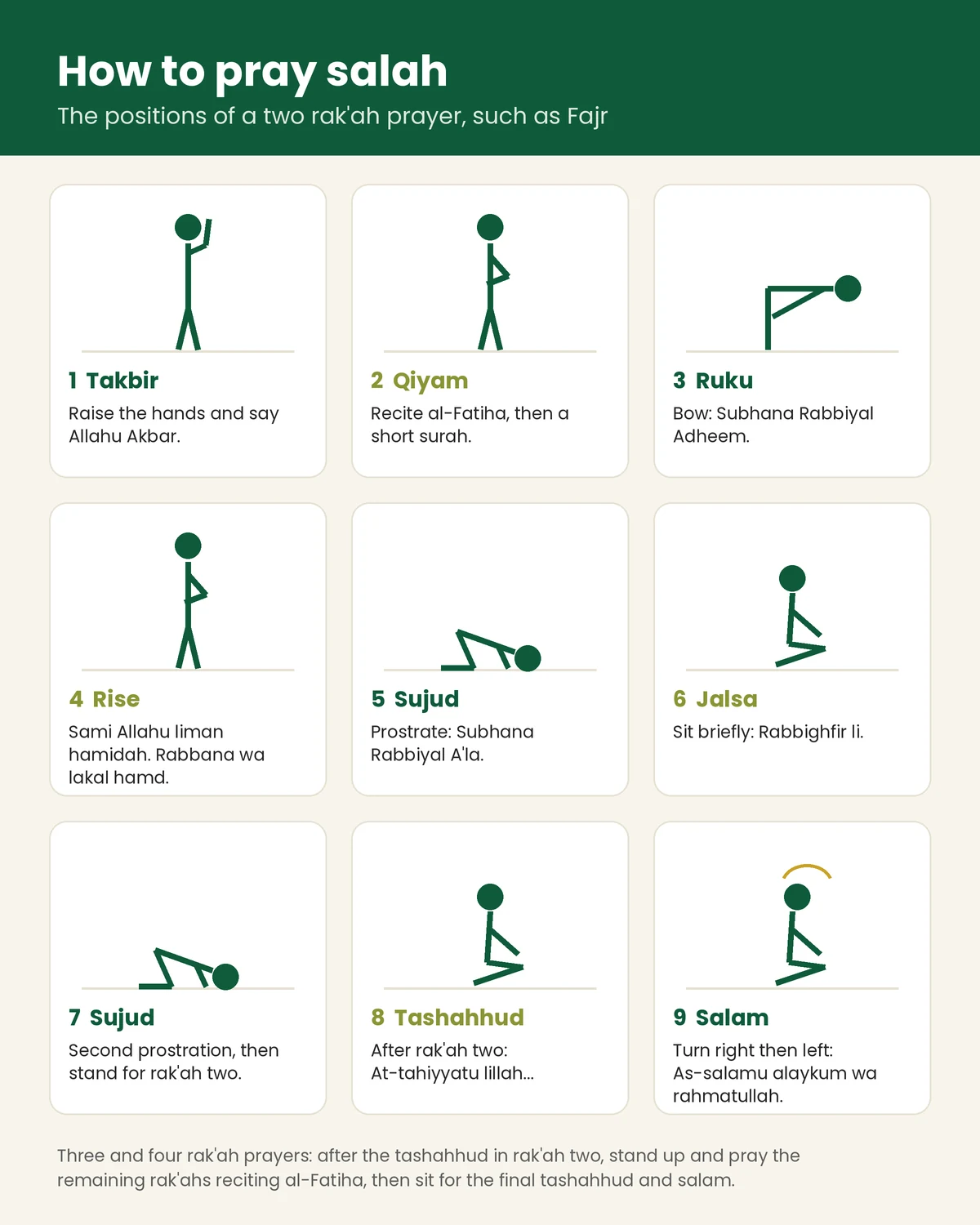
How to pray: a two rak’ah prayer step by step
The Prophet once taught a man who had been rushing his prayer: “When you stand for prayer, say takbir, then recite what you can of the Qur’an, then bow until you are at ease in bowing, then rise until you stand straight, then prostrate until you are at ease in prostration, then sit until you are at ease sitting, and do that throughout your prayer” (Bukhari 757). Calm and stillness in every position are part of the prayer itself. Here is the full sequence:
- Intention. Stand facing the qiblah and intend, in your heart, the prayer you are about to pray (for example, the two rak’ahs of Fajr).
- Opening takbir. Raise your hands to the level of your shoulders or ears and say Allahu Akbar (Allah is the Greatest). This begins the prayer; the Prophet called takbir its opening and salam its close (Tirmidhi 3). Then place your right hand over your left on your chest or below it, as your school teaches.
- Recite al-Fatiha. Many begin with a short opening supplication and seek refuge in Allah from Satan. Then recite Surah al-Fatiha, which is required in every rak’ah: “Whoever does not recite al-Fatiha, his prayer is invalid” (Bukhari 756). Say Amin at the end.
بِسْمِ اللَّهِ الرَّحْمَٰنِ الرَّحِيمِ الْحَمْدُ لِلَّهِ رَبِّ الْعَالَمِينَ الرَّحْمَٰنِ الرَّحِيمِ مَالِكِ يَوْمِ الدِّينِ إِيَّاكَ نَعْبُدُ وَإِيَّاكَ نَسْتَعِينُ اهْدِنَا الصِّرَاطَ الْمُسْتَقِيمَ صِرَاطَ الَّذِينَ أَنْعَمْتَ عَلَيْهِمْ غَيْرِ الْمَغْضُوبِ عَلَيْهِمْ وَلَا الضَّالِّينَ
Bismillahir-Rahmanir-Rahim. Al-hamdu lillahi Rabbil-‘alamin. Ar-Rahmanir-Rahim. Maliki yawmid-din. Iyyaka na’budu wa iyyaka nasta’in. Ihdinas-siratal-mustaqim. Siratal-ladhina an’amta ‘alayhim, ghayril-maghdubi ‘alayhim wa lad-dallin.
In the name of Allah, the Most Merciful, the Especially Merciful. All praise is for Allah, Lord of all the worlds, the Most Merciful, the Especially Merciful, Master of the Day of Judgement. You alone we worship and You alone we ask for help. Guide us to the straight path, the path of those You have blessed, not of those who earned anger, nor of those who went astray.
- Recite a short surah. In the first two rak’ahs, recite another passage of the Qur’an after al-Fatiha. Surah al-Ikhlas is short and easy to learn: Qul huwallahu ahad. Allahus-samad. Lam yalid wa lam yulad. Wa lam yakun lahu kufuwan ahad (“Say: He is Allah, the One. Allah, the Eternal Refuge. He neither begets nor is born, nor is there any equivalent to Him”).
قُلْ هُوَ اللَّهُ أَحَدٌ اللَّهُ الصَّمَدُ لَمْ يَلِدْ وَلَمْ يُولَدْ وَلَمْ يَكُن لَّهُ كُفُوًا أَحَدٌ
- Bow (ruku’). Say Allahu Akbar and bow, hands on your knees and back straight. Say three times Subhana Rabbiyal-‘Adhim (Glory be to my Lord, the Magnificent) (Abu Dawud 871).
- Rise from bowing. Stand up straight saying Sami’allahu liman hamidah (Allah hears the one who praises Him), then, once standing, Rabbana wa lakal-hamd (Our Lord, to You belongs all praise) (Bukhari 789). Pause until you are fully still.
- Prostrate (sujud). Say Allahu Akbar and go down to prostrate on the seven parts of the body the Prophet named: the forehead with the nose, both hands, both knees and the toes of both feet (Bukhari 812). Say three times Subhana Rabbiyal-A’la (Glory be to my Lord, the Most High) (Abu Dawud 871).
- Sit between the prostrations. Say Allahu Akbar and sit up, still and at ease. A common supplication here is Rabbighfir li (My Lord, forgive me).
- Second prostration. Say Allahu Akbar and prostrate again as before. This completes the first rak’ah.
- Stand for the second rak’ah. Say Allahu Akbar and stand. Pray the second rak’ah exactly like the first (al-Fatiha, a short surah, bowing, rising and two prostrations), without the opening takbir and supplication.
- Sit for the tashahhud. After the second prostration of the second rak’ah, stay seated and recite the tashahhud the Prophet taught Ibn Mas’ud (Bukhari 831):
التَّحِيَّاتُ لِلَّهِ، وَالصَّلَوَاتُ وَالطَّيِّبَاتُ، السَّلاَمُ عَلَيْكَ أَيُّهَا النَّبِيُّ وَرَحْمَةُ اللَّهِ وَبَرَكَاتُهُ، السَّلاَمُ عَلَيْنَا وَعَلَى عِبَادِ اللَّهِ الصَّالِحِينَ، أَشْهَدُ أَنْ لاَ إِلَهَ إِلاَّ اللَّهُ، وَأَشْهَدُ أَنَّ مُحَمَّدًا عَبْدُهُ وَرَسُولُهُ
At-tahiyyatu lillahi was-salawatu wat-tayyibat. As-salamu ‘alayka ayyuhan-Nabiyyu wa rahmatullahi wa barakatuh. As-salamu ‘alayna wa ‘ala ‘ibadillahis-salihin. Ashhadu an la ilaha illallah, wa ashhadu anna Muhammadan ‘abduhu wa rasuluh.
All greetings, prayers and good things are for Allah. Peace be upon you, O Prophet, and the mercy of Allah and His blessings. Peace be upon us and upon the righteous servants of Allah. I bear witness that there is no god but Allah, and I bear witness that Muhammad is His servant and His Messenger.
- Send blessings on the Prophet. Then recite the salawat on the Prophet, as he taught Ka’b ibn ‘Ujrah (Bukhari 3370):
اللَّهُمَّ صَلِّ عَلَى مُحَمَّدٍ وَعَلَى آلِ مُحَمَّدٍ، كَمَا صَلَّيْتَ عَلَى إِبْرَاهِيمَ وَعَلَى آلِ إِبْرَاهِيمَ، إِنَّكَ حَمِيدٌ مَجِيدٌ، اللَّهُمَّ بَارِكْ عَلَى مُحَمَّدٍ وَعَلَى آلِ مُحَمَّدٍ، كَمَا بَارَكْتَ عَلَى إِبْرَاهِيمَ وَعَلَى آلِ إِبْرَاهِيمَ، إِنَّكَ حَمِيدٌ مَجِيدٌ
Allahumma salli ‘ala Muhammadin wa ‘ala ali Muhammad, kama sallayta ‘ala Ibrahima wa ‘ala ali Ibrahim, innaka Hamidum Majid. Allahumma barik ‘ala Muhammadin wa ‘ala ali Muhammad, kama barakta ‘ala Ibrahima wa ‘ala ali Ibrahim, innaka Hamidum Majid.
O Allah, send prayers upon Muhammad and the family of Muhammad, as You sent prayers upon Ibrahim and the family of Ibrahim; You are Praiseworthy, Glorious. O Allah, bless Muhammad and the family of Muhammad, as You blessed Ibrahim and the family of Ibrahim; You are Praiseworthy, Glorious.
- Close with salam. Turn your head to the right saying As-salamu ‘alaykum wa rahmatullah (Peace and the mercy of Allah be upon you), then to the left saying the same. Your prayer is complete.
Three and four rak’ah prayers
For Maghrib (three rak’ahs) and Dhuhr, Asr and Isha (four rak’ahs), sit after the second rak’ah and recite only the tashahhud, then say Allahu Akbar and stand up (Bukhari 789). In the remaining rak’ahs recite al-Fatiha alone, then complete the bowing and prostrations as before. After the last rak’ah sit for the full tashahhud, the salawat and the salam.
Differences between the schools
Muslims around the world pray with small differences: where the hands are placed, how often the hands are raised, whether Amin is said aloud, and how one sits. These come from different authentic reports and the reasoning of the four schools of law, and all of them are valid. If you have learned the prayer in one way, keep to it; if you are new, learn one method well from a teacher you trust and do not worry about the variations you see in the masjid.
Frequently asked questions
What if I cannot recite al-Fatiha in Arabic yet?
Start learning it straight away; it is short and most people learn it in a few days with help. While you are learning, the Prophet taught a man who could not yet memorise any Qur’an to say Subhanallah, Alhamdulillah, La ilaha illallah, Allahu Akbar and La hawla wa la quwwata illa billah (Abu Dawud 832). Our Quran classes can help you learn.
Which direction is the qiblah in Wellington?
From Wellington the Kaaba in Makkah lies about 256 degrees from true north, roughly west-southwest. A magnetic compass in Wellington points about 23 degrees east of true north, so on a compass the qiblah reads about 233 degrees. A qiblah app on your phone is the easiest way to check.
What should I do if I forget how many rak’ahs I have prayed?
Go with the number you are sure of, complete the prayer from there, and make two extra prostrations (sujud al-sahw) before the salam. The Prophet taught this in Muslim 571.
Do women pray differently?
The essentials are the same for men and women: the same positions, recitations and number of rak’ahs. Some schools recommend small differences in posture for women. Women may pray at home or at the centre.
Can I pray at work or university in New Zealand?
Yes. New Zealand’s Human Rights Act requires employers to accommodate religious practice unless it causes unreasonable disruption. The Guiding Light Foundation has a practical guide to praying, Jumu’ah and Ramadan at work in New Zealand and Australia.
Sources
- Sahih al-Bukhari 631: “Pray as you have seen me praying.”
- Sahih al-Bukhari 756: al-Fatiha is required in prayer.
- Sahih al-Bukhari 757: the Prophet teaches the man who rushed his prayer.
- Sahih al-Bukhari 789: the takbirs and the words on rising from bowing.
- Sahih al-Bukhari 812: prostration on seven parts of the body.
- Sahih al-Bukhari 831: the tashahhud of Ibn Mas’ud.
- Sahih al-Bukhari 3370: the salawat on the Prophet.
- Sunan Abi Dawud 871: the glorifications in bowing and prostration (graded sahih).
- Sunan Abi Dawud 832: remembrance for one who cannot yet recite the Qur’an.
- Sahih Muslim 571: what to do when unsure how many rak’ahs were prayed.
- Jami at-Tirmidhi 3: takbir opens the prayer and salam closes it (graded hasan).